Mastercard Incorporated MA
Revenue Intelligence Report • 70 quarters of SEC filing data • Updated 2026-03-15
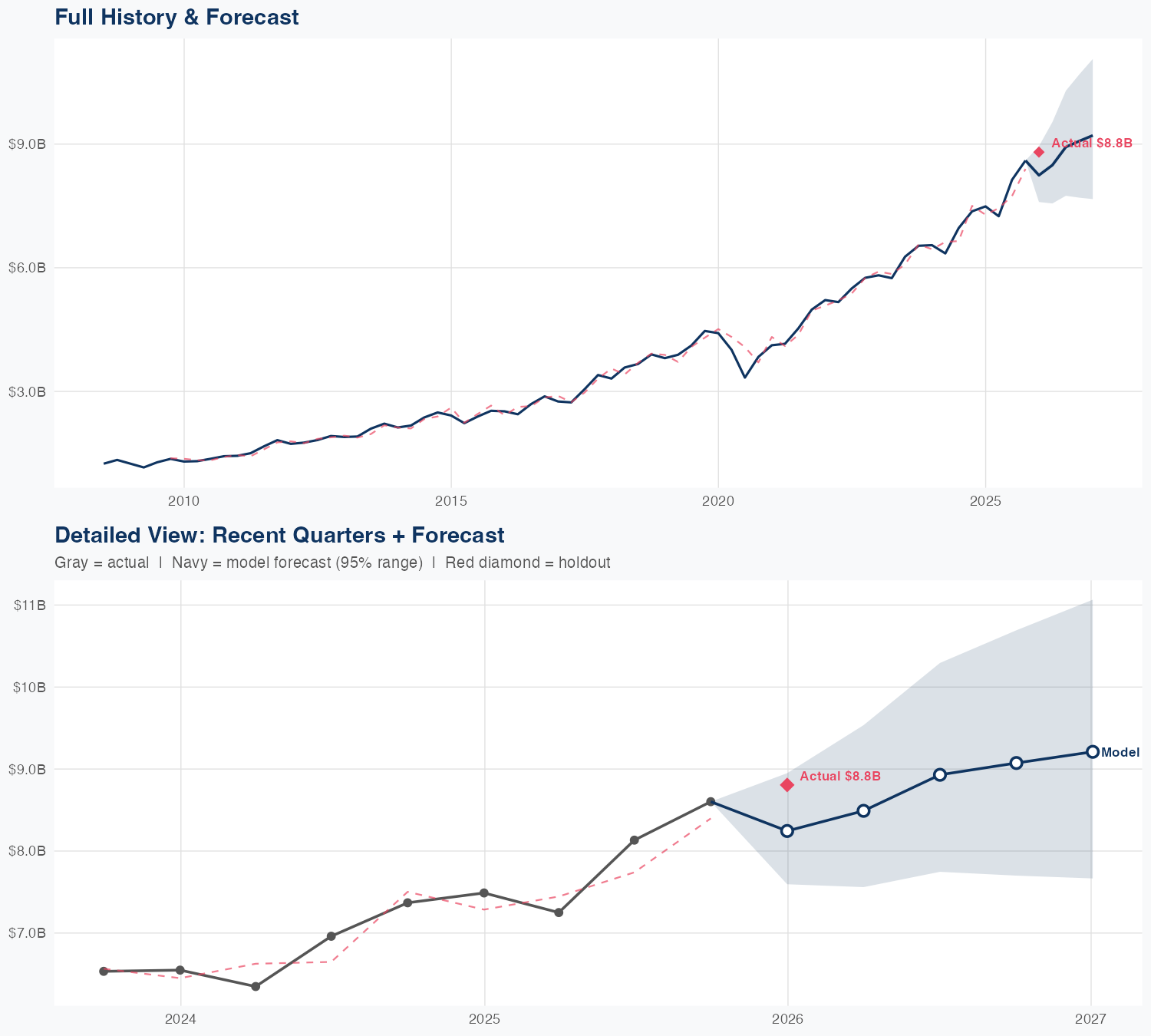
Mastercard Incorporated has a forecasted full-year revenue of $36B, a +8.9% year-over-year change, based on 70 quarters of SEC filing data. Key revenue drivers include SG&A (elasticity 0.92x). The ARDL model achieves strong accuracy at 3.1% MAPE.
Investment Thesis
The econometric model achieves strong accuracy (3.1% MAPE), suggesting Mastercard Incorporated's revenue trajectory is well-characterized by its spending patterns. Sales & marketing spend shows a 0.92x elasticity, suggesting effective go-to-market execution.
Next FY Revenue
$35.7B
+8.9% YoY
SG&A Elasticity
0.92x
Model Accuracy
3.1% MAPE
Holdout validation: The model predicted $8.2B vs the actual $8.8B — an error of 6.4%.
Note:
Mastercard Incorporated does not report R&D expenses separately. This analysis uses SG&A spending only.
Revenue Forecast
Quarterly Detail
| Quarter | Model Forecast | Actual | 95% Range | YoY Growth | Status |
|---|---|---|---|---|---|
| Q4 2025 | $8.2B | $8.8B | $7.6B – $8.9B | +10.1% | ✓ In range |
| Q2 2026 | $8.5B | $7.6B – $9.5B | +17.1% | ||
| Q3 2026 | $8.9B | $7.7B – $10B | +9.8% | ||
| Q4 2026 | $9.1B | $7.7B – $11B | +5.5% | ||
| Q1 2027 | $9.2B | $7.7B – $11B | +4.6% |
Seasonal Factors
Multiplicative seasonal adjustment:
These factors capture Mastercard Incorporated's systematic quarterly revenue patterns relative to the trend model.
A factor of 1.05 means that quarter typically runs 5% above the underlying trend; 0.95 means 5% below.
Factors are computed as the median of (actual / fitted) across all available quarters.
| Fiscal Quarter | Seasonal Factor | vs Trend | Interpretation | Obs. |
|---|---|---|---|---|
| FQ1 (Sep–Nov) | 1.0124 | +1.2% | In line with trend | 17 |
| FQ2 (Dec–Feb) | 0.9834 | -1.7% | In line with trend | 17 |
| FQ3 (Mar–May) | 0.9976 | -0.2% | In line with trend | 16 |
| FQ4 (Jun–Aug) | 1.027 | +2.7% | In line with trend | 16 |
How Spending Drives Revenue
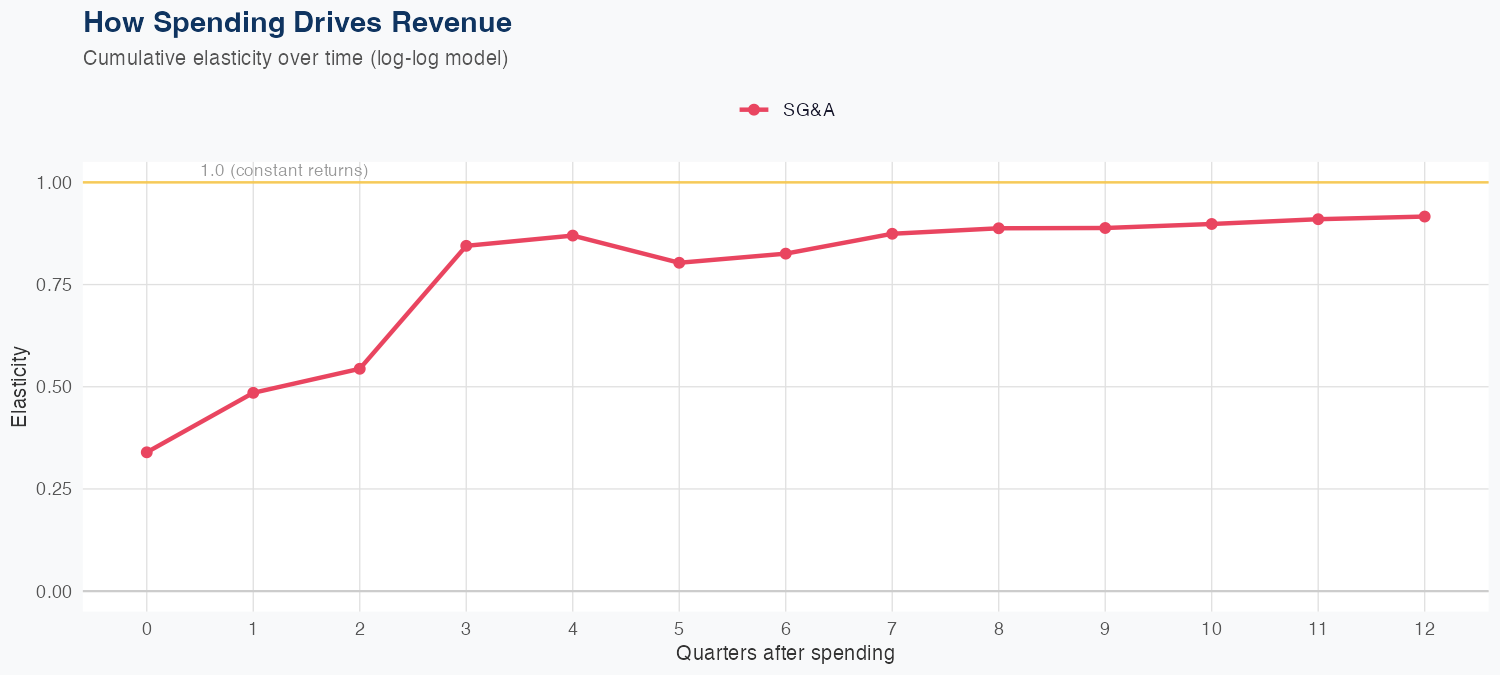
Reading this chart:
Each line shows the cumulative elasticity — how a 1% increase in spending translates to revenue growth over subsequent quarters. The effect builds over 4-5 quarters as investments compound.
Want this analysis for your portfolio?
I build custom revenue intelligence reports for investors and companies using SEC filing data, econometric modeling, and AI-powered insights.
Get in Touch